
Research: Does My Engagement Drop with Automation on X?
Scheduling and AI drafts held engagement steady in every study we found. Automated replies, likes and follows are what cost you reach on X.
Does your engagement drop with automation on X? For scheduling and AI-assisted drafting, the published evidence says it holds steady: scheduler tests found no consistent reach penalty, and AI-assisted posts matched or beat human-only ones. Engagement drops when you automate the social part of X, the replies, likes and follows, which X's rules ban and its feed scores hard against. Keep a person approving every post and sending every reply, and automation mostly buys you consistency, which the data links to more engagement.
We read the published experiments, X's ranking code, X's own rules and the academic research on AI-written text, and checked every source in October 2026. Each finding below links to its source so you can check it yourself. Where a study is small or run by a company with something to sell, we say so.
1. Scheduled posts reach as many people as native ones
The oldest worry about automation is that X quietly shows fewer people a post that came from a scheduling app. Three public tests have checked it directly.
- Buffer, 2018. Over three weeks, 11 brands posted the same kinds of content through Hootsuite, CoSchedule and Buffer, and natively. On Twitter, with 45 posts each way, scheduled posts averaged 21,108 impressions against 21,671 for native ones, a 2.6% gap. Facebook and LinkedIn tilted the other way, towards the tools. Buffer found no significant difference in reach or engagement.
- Agorapulse Social Media Lab, 2018. Three Twitter accounts each spent a week on four scheduling apps and a week posting by hand. The apps averaged 10.3% fewer impressions overall, but one account saw 86.5% more through the apps and another 31.9% fewer. The author called it a draw with no penalty on scheduled tweets.
- Hootsuite, 2025. On one Instagram account, five scheduled posts earned an 8.19% engagement rate against 6.44% for five native posts. The author is clear that the sample is too small to call.
These are small tests, run by companies that sell schedulers, and the newest one on X dates from 2018. What makes them persuasive is the pattern: the gaps point in different directions from account to account, which is what random variation looks like. A real penalty would show up the same way every time.
X itself treats scheduling as normal. Its automation rules allow automated posts, and X Pro includes a scheduler of its own (both at the time of writing, October 2026). Your followers also can't see which app you used: Twitter removed the "Twitter for iPhone" style source label from posts in December 2022.
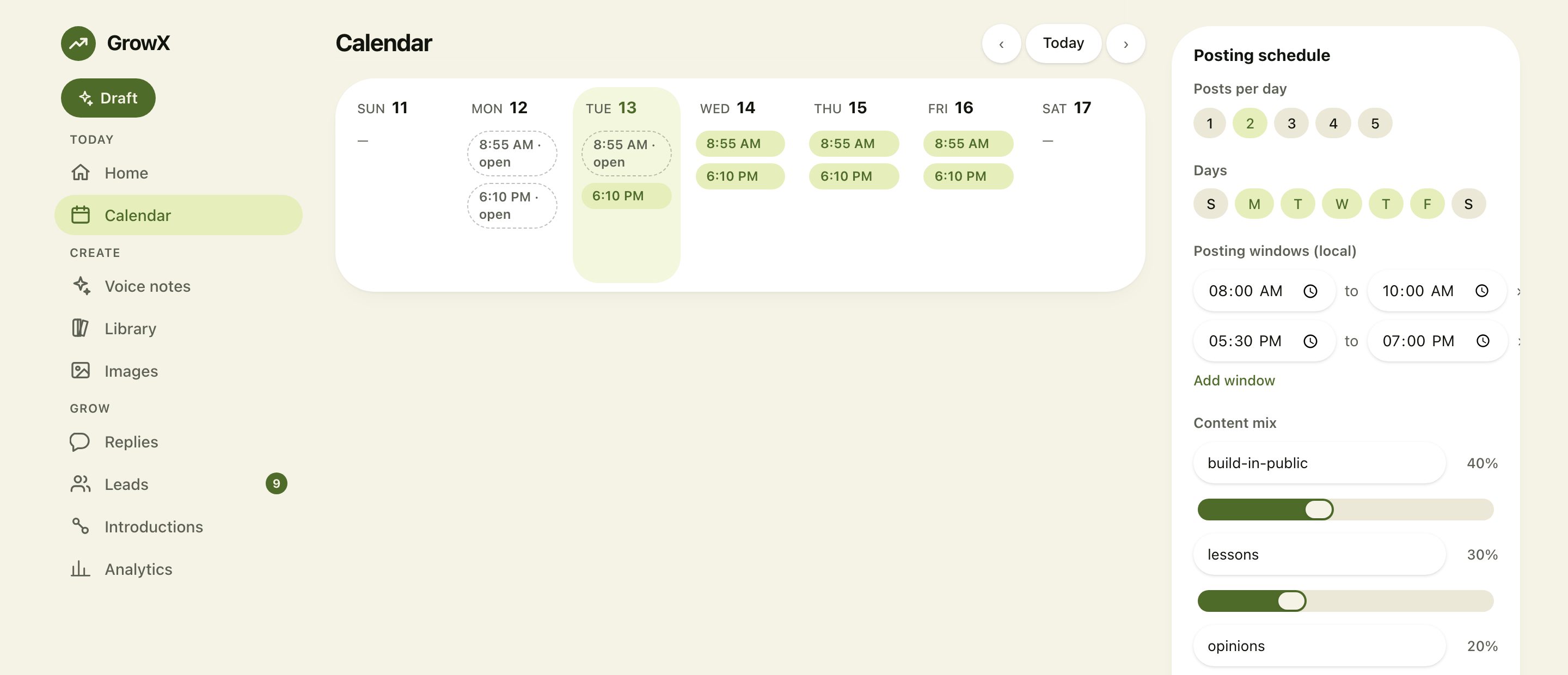
GrowX works the same way. Each post you approve waits in a slot on the calendar and publishes at its time through X's official API, the same route every scheduler uses.
2. X's feed code scores readers' reactions
X published the code behind its For You feed in the xai-org/x-algorithm repository. It describes a model that predicts how likely each reader is to favourite, reply to, repost, quote, share or click a post, or follow its author, and how likely they are to mark it "not interested", mute the author, block them or report the post. The final score is a weighted sum of those predictions.
The weights in the repository's parameter file show how lopsided that sum is, at the time of writing (October 2026):
| Predicted action | Weight |
|---|---|
| Favourite | 0.66 |
| Reply | 5.0 |
| Follow the author | 4.0 |
| Not interested | −52.272 |
| Mute the author | −58.8 |
| Report | −234.0 |
The weights multiply predicted probabilities, so they don't convert into "one report equals N likes". They do show the direction: a post that makes readers want to mute you costs far more than a post that makes them reply earns.
What the code leaves out matters as much. We looked for any input about the app that published a post, in this repository and in Twitter's 2023 release. The ranking inputs describe the reader and the reactions they are predicted to have. The publishing app is absent from the scoring, which fits with the scheduler tests above.
Two parts of the code do bear on how you automate:
- Posts older than 48 hours drop out of the candidates. Timing matters, so schedule for the hours your audience is awake.
- Repeat posts by the same author in one feed are scored down step by step. Flooding the timeline buys less with every extra post, and the 2023 code flagged clusters of duplicate text as spam. Vary what you publish.
3. AI-assisted posts held their engagement
The second worry is that readers turn away from posts an AI helped to write. The largest dataset we found says the opposite.
In October 2024 Buffer compared 1.2 million posts from 15,000 users who published both with and without its AI Assistant, using each user's median engagement rate. AI-assisted posts came out ahead on every platform studied.
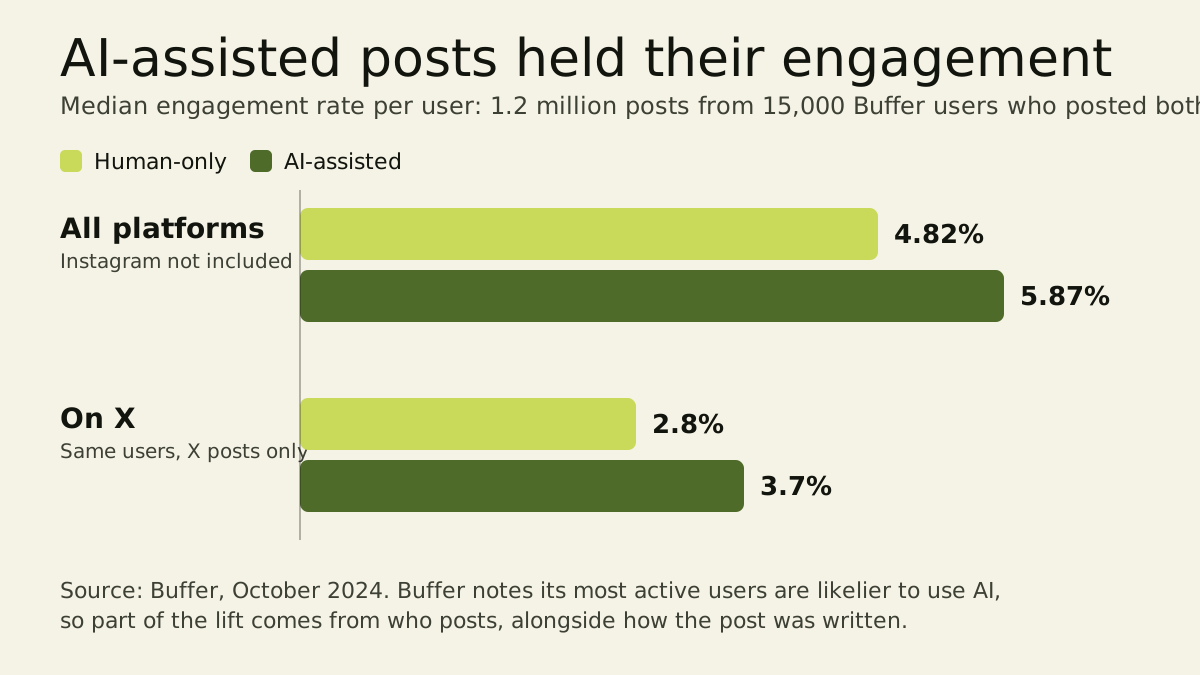
Buffer flags its own caveat: its most active users are the likeliest to use AI, which lifts the AI-assisted figure. The fair reading is that AI help held engagement steady, with some of the lift coming from who uses it. Two further studies point the same way:
- A 2025 study in Public Relations Review compared Fortune 500 companies' tweets and ran experiments, and found AI-optimised content drew more likes, comments and shares.
- In a field experiment, 2,234 people made 11,024 ads in either human pairs or human and AI pairs, and the ads ran on X for about 5 million impressions. The human and AI pairs wrote better ad text, and better text earned higher click-through rates. It is a preprint, so treat it as early evidence.
The common thread is a person working with the AI. None of these studies measured fully unattended posting.
4. Readers struggle to tell AI writing from human writing
If readers could spot AI text on sight, every AI-assisted post would be a risk. Controlled studies show most people can't.
- In a 2023 Science Advances study, 697 people could not reliably tell tweets written by GPT-3 from tweets by real users.
- Across six experiments with 4,600 participants, people failed to detect AI-written self-descriptions and leaned on misleading cues such as first-person pronouns and family topics (PNAS, 2023).
- In a 2025 Pew Research Center survey of 5,023 US adults, 53% said they were not confident they could tell AI-made content from human content, while 76% said being able to tell was extremely or very important.
That last pair is the tension to manage. People care a lot about whether a person is behind what they read, and they can't check it by reading. So they judge by everything around the words: whether the account replies like a person, whether the opinions sound lived, whether the feed reads like one voice.
5. Engagement drops when readers believe no human was involved
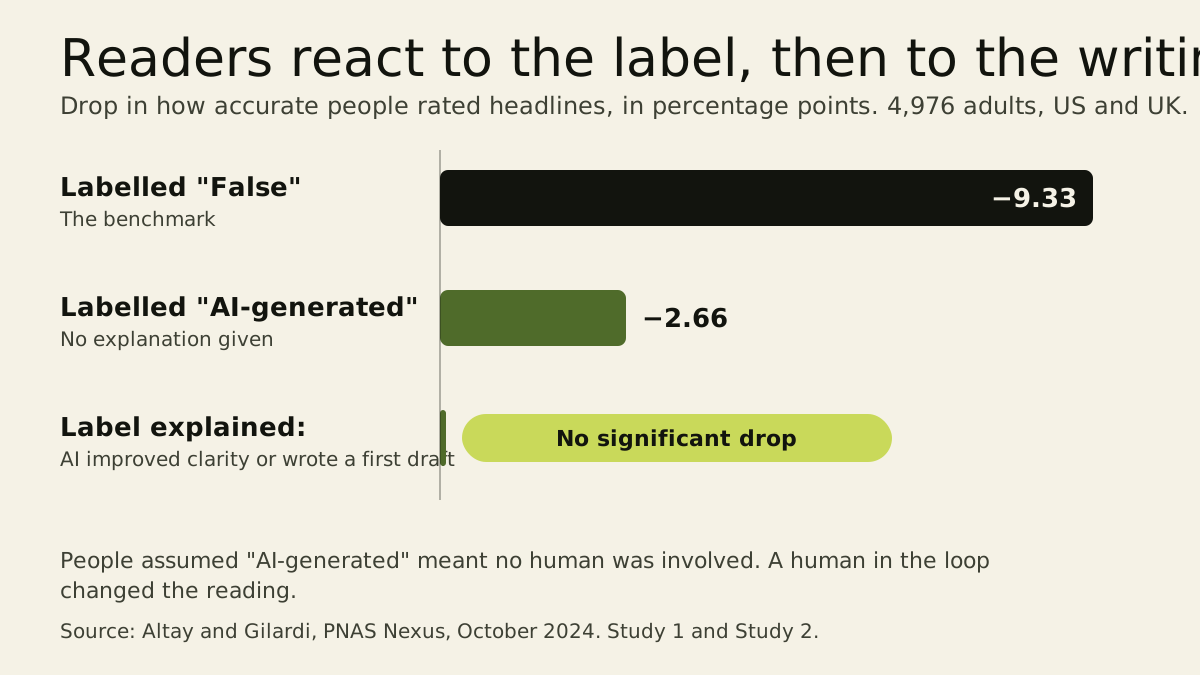
The research on AI labels explains where the real penalty sits. In two experiments with 4,976 people in the US and UK, labelling headlines "AI-generated" lowered how accurate people rated them by 2.66 percentage points, even when the headlines were true and written by humans. People assumed the label meant no human had been involved. When the label explained that AI had only improved clarity or written a first draft, the drop was no longer statistically significant.
Other studies sharpen the point:
- Across seven experiments, people who believed an emotional brand message was written by AI spread less positive word of mouth and showed less loyalty. The effect was weaker for factual messages and when AI only edited the text (Journal of Business Research, 2025).
- In a 2023 survey of 4,508 consumers, 62% said they were less likely to engage with or trust content they knew was AI-made.
The lesson for your account: let AI help with structure, clarity and first drafts, and keep the parts that carry your judgement in your own words. Your opinions, your stories and your numbers are what readers come for, and they are exactly the parts readers punish when they sound machine-made.
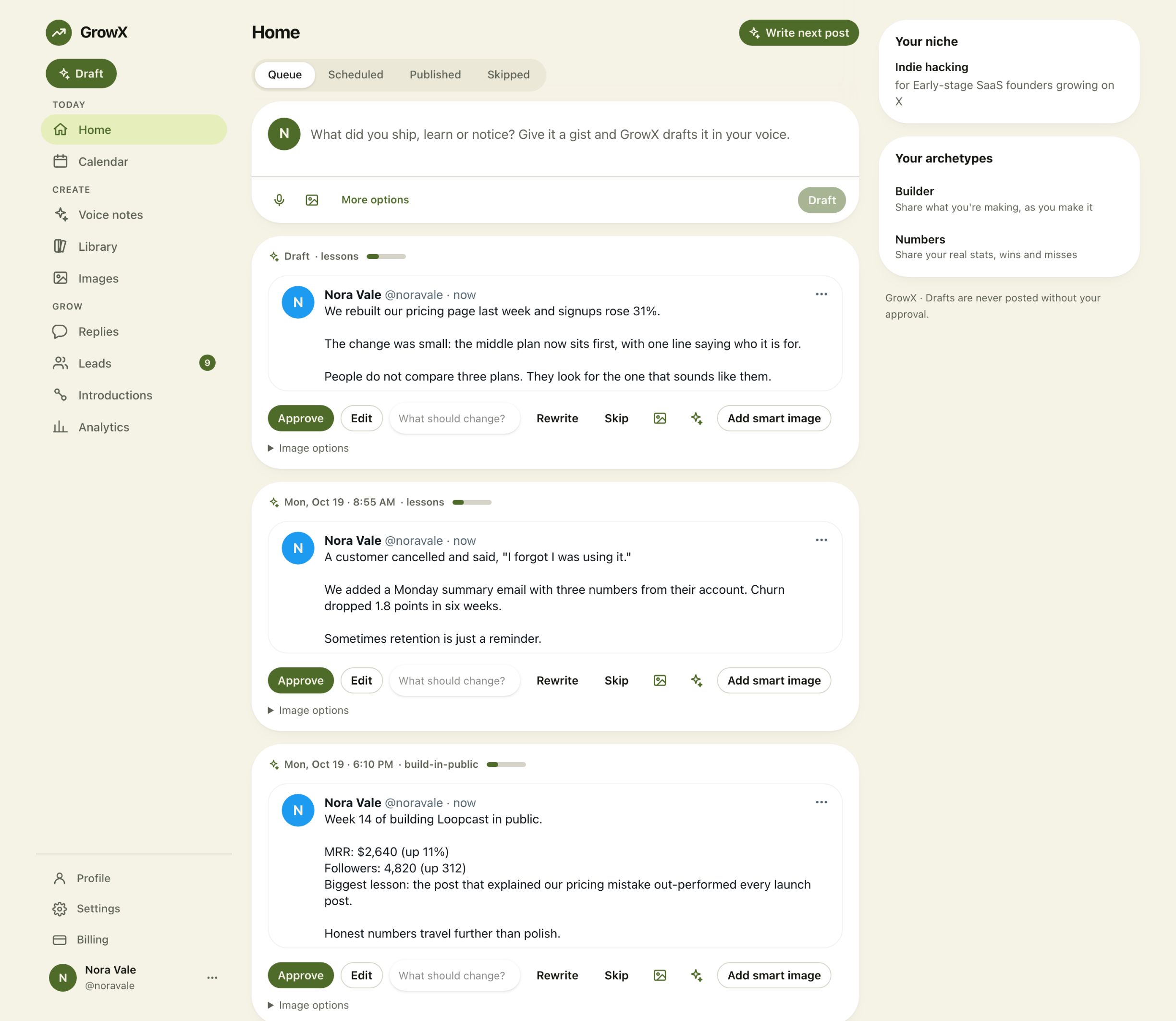
This is the loop GrowX is built around. It learns your voice from your own past posts and the Voice Drops you record, drafts posts from them, and holds every draft in a queue until you approve, edit or rewrite it.
6. Automated replies, likes and follows are where reach disappears
Here the evidence turns firmly against automation. X's rules, its API and its feed all treat automated engagement as spam.
What X's automation rules say, at the time of writing (updated April 2026):
- Liking posts in an automated way is banned.
- Automated replies triggered by keyword searches are banned. Automated replies are allowed only to people who asked for them, once per interaction, and an AI reply bot needs X's written approval in advance.
- Bulk or aggressive following and unfollowing is banned, as is posting the same or very similar content across accounts.
- Breaking the rules can remove your posts from search or get the account suspended.
X's authenticity policy adds bulk unsolicited replies to the list and spells out the reach limits: removal from For You and Following, from search and from trends, and lower placement inside reply threads. Since 23 February 2026, replies sent through the self-serve X API only go through when the original author mentioned or quoted the replying account, a change X made to fight AI-generated reply spam.
The feed math from section 2 explains why reply bots backfire even before enforcement arrives. A generic reply under a stranger's post is the kind of content that earns "not interested", mutes and blocks, and those predictions carry the heaviest negative weights in the score.
Research on AI-suggested replies shows the healthy version. In two experiments published in Scientific Reports, AI-suggested replies made conversations faster and left partners feeling closer, while people suspected of leaning on algorithmic responses were judged more harshly. AI can help you find the words. The reply lands when it is clearly yours.
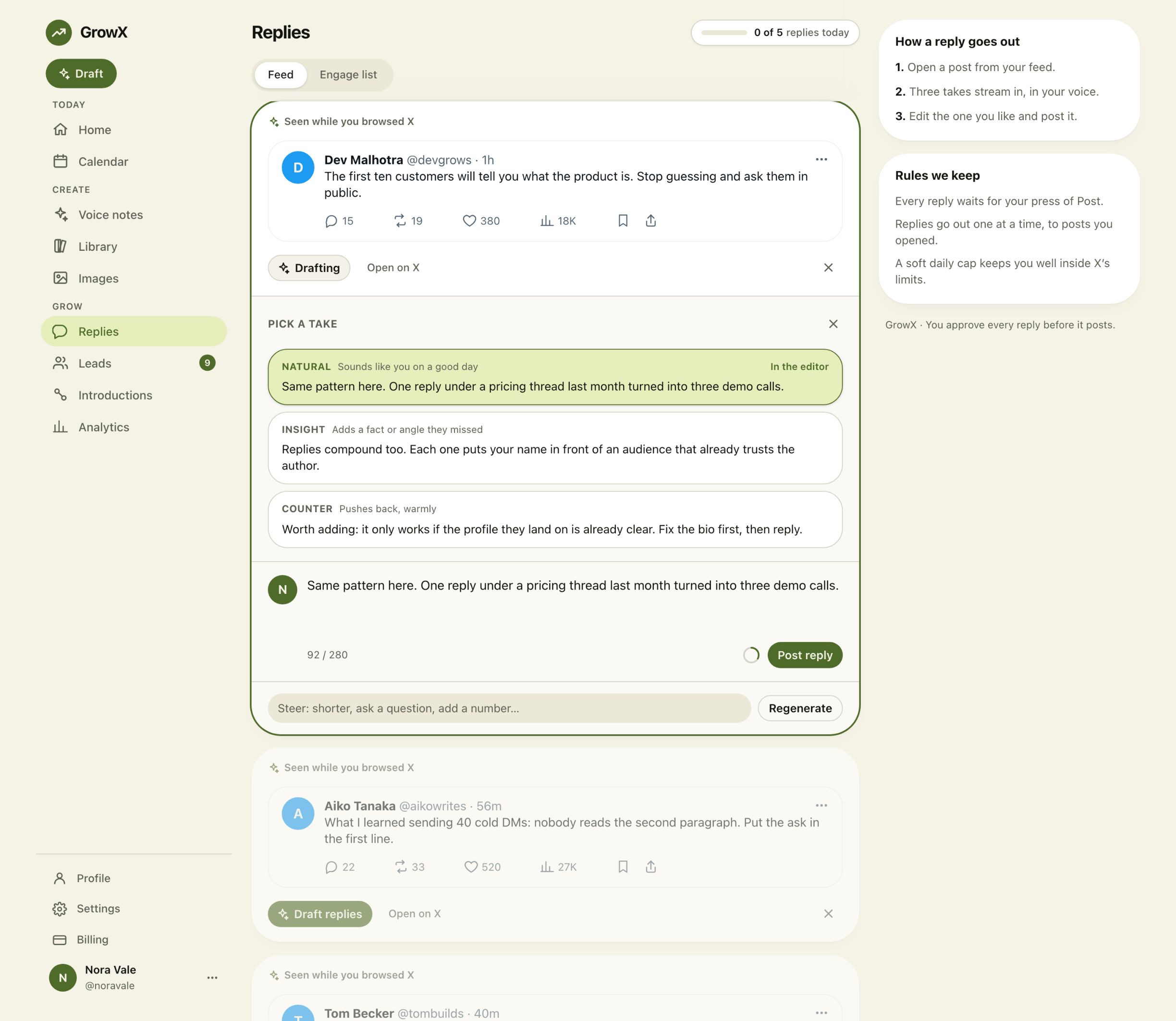
In GrowX, replies stay in your hands by design. The Chrome extension drafts three takes in your voice on the post you are reading, puts the one you choose into X's own reply box, and you press Reply.
7. Consistency is the upside automation buys
The strongest argument for automation is what it does to your posting rhythm. In January 2025 Buffer studied more than 100,000 users over 26 weeks. Users who posted in 20 or more of those weeks got about 5 times the engagement per post of users who posted in 4 weeks or fewer, and engagement kept rising until about 21 weeks of steady posting.
Buffer's 2026 State of Social Media Engagement report, built on more than 52 million posts, adds two refinements. Accounts grew more slowly than their own baseline in weeks they skipped, and reach per post tends to decline at higher posting frequencies. The target is a steady cadence you can hold for months, at a volume your audience wants to read.
Both studies are correlations across Buffer's users and all platforms together, so they can't prove that consistency causes the lift on X. They do match the feed code: a steady stream of fresh posts gives the 48-hour window something new from you every day.
8. How to automate without an engagement drop
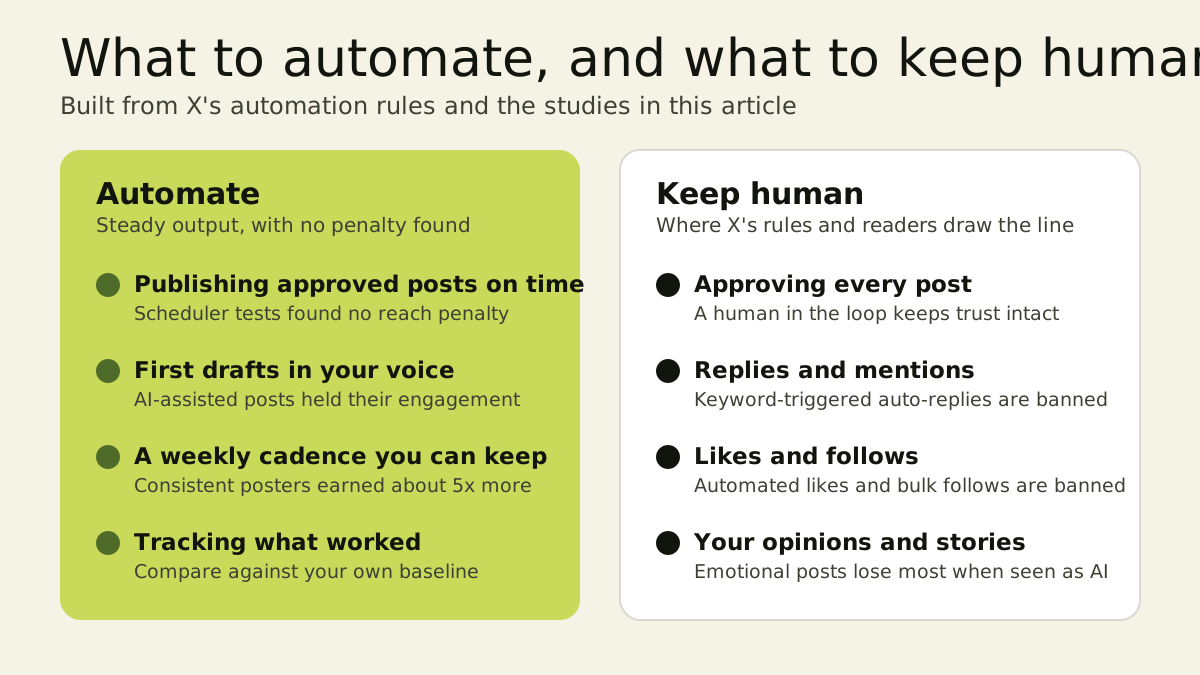
Put the research together and the split is clear:
- Automate publishing. Schedule approved posts for the hours your audience is awake. Start from the windows in our best-time guide and test your own.
- Use AI for first drafts. Feed it your own past posts and notes, then add the opinion, story or number only you have.
- Approve every post. A person in charge of the final word is what removes the AI penalty in the label research.
- Write every reply yourself. Use drafts for speed, and send each one by hand on posts you have actually read.
- Never automate likes or follows. X bans both, and nothing in the data suggests they help.
- Vary your posts. Skip duplicate text and near-copies, on one account or across several.
- Pick a cadence you can keep for 20 weeks. Steady weekly posting beats bursts.
What results to expect
If you move from posting by hand to scheduling, expect your engagement per post to stay about where it was. The tests above saw average gaps of 3% to 10%, pointing different ways on different accounts.
Measure it on your own account for four weeks: compare posts of the same format, posted at similar times, before and after. Avoid comparing yourself with industry benchmarks, because they disagree with each other. For brands on X, Quid's Rival IQ report puts the median at 0.03% engagement per follower per post in 2026, while Buffer's 2026 report, measured a different way, lands near 2.5%. Your own baseline is the only fair comparison.
The gains from consistency take longer. In Buffer's data, engagement kept climbing until about five months of steady weekly posting. Automation makes those five months realistic; the content still has to earn the reactions.
Frequently asked questions
Does X penalise posts from scheduling tools?
No published test or X statement shows a penalty. Buffer's and Agorapulse's tests found differences that swung both ways from account to account, X's automation rules allow scheduled posts, and X Pro has its own scheduler.
Can X tell which app I used to post?
X's systems record the posting app, but its open-source feed code doesn't use it to score posts, and followers no longer see a source label since Twitter removed it in December 2022.
Do AI-written posts get less engagement on X?
In Buffer's study of 1.2 million posts, AI-assisted X posts had a median engagement rate of 3.7% against 2.8% for human-only posts. The penalty appears when readers believe no human was involved, so keep your own judgement in every post and approve it before it goes out.
Can I use auto-replies or auto-likes on X?
Automated likes are banned under X's automation rules, and automated replies are allowed only to people who opted in, one per interaction. Since February 2026 the self-serve X API also blocks replies unless the original author mentioned or quoted your account.
How often should I post on X to keep engagement up?
Post at least weekly and keep it up. Buffer found users who posted in 20 or more of 26 weeks got about 5 times the engagement per post of those who posted in 4 weeks or fewer, while reach per post tends to drop at higher frequencies.
Will automation get my X account suspended?
Scheduling approved posts through the official API is allowed. Suspensions follow the automation X bans: automated likes, keyword-triggered replies, bulk following and duplicate posts across accounts.
Related articles
- How to Schedule Posts on X: Step by Step
- The Best Time to Post on X in 2026 (and How to Find Yours)
- How to Grow on X with Replies: The Fastest Path for Small Accounts
- How to Grow on X in 2026: A Step-by-Step Playbook
Automate the busywork, keep the voice yours
GrowX automates the parts the research says are safe and keeps you in charge of the rest. It drafts posts in your voice from your own posts and Voice Drops, publishes only what you approve at the times you choose, and drafts replies you send yourself. Start with GrowX and keep posting steadily without losing what makes your account yours.